
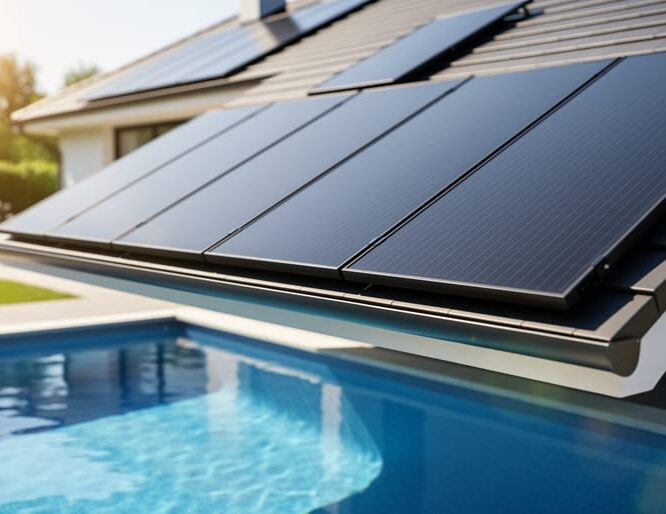
Calculating solar collector heat output is straightforward: multiply your collector area (in square feet) by the peak solar insolation in your region (typically 250-350 BTU per square foot per hour) to determine hourly heat gain, then compare this against your pool’s heating load to verify adequate coverage. Most residential pool owners need between 50% and 100% of their pool surface area in solar collectors to maintain comfortable swimming temperatures, depending on climate, desired temperature, and pool usage patterns.
Understanding these numbers before you buy ensures your solar pool heating system delivers the performance you expect. Too small a system leaves you with lukewarm water on cloudy days, while proper sizing extends your swim season by weeks or even months without ongoing energy costs. The calculation process requires just basic measurements and freely available climate data, making it accessible even if you’ve never worked with BTU values before.
This guide walks you through the complete sizing calculation, from gathering your pool dimensions and local insolation values to running the final math that tells you exactly how many square feet of collector surface you need. You’ll also learn how to factor in efficiency losses, verify your results, and adjust for variables like shade coverage or desired temperature rise, giving you confidence that your investment will perform as expected from installation day forward.
What You’ll Need to Calculate Solar Collector Heat
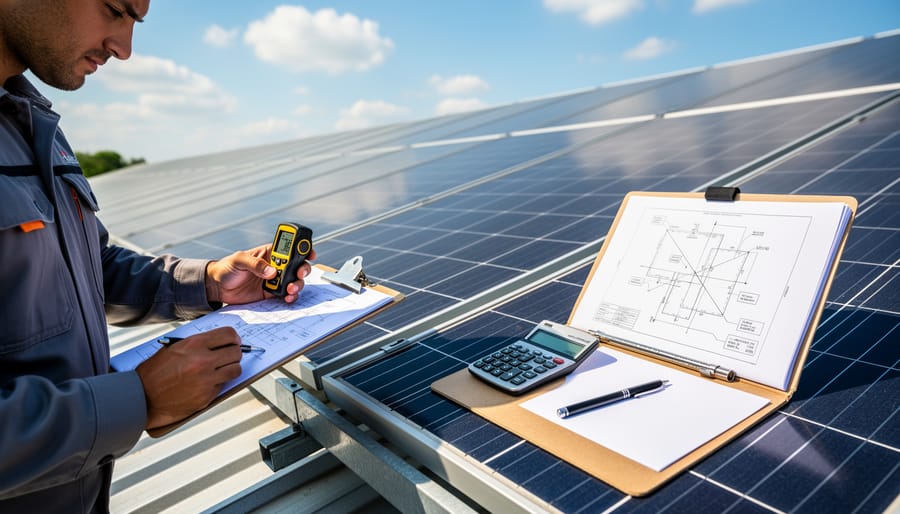
Before you start crunching numbers, gather the essential information and tools that will make your heat output calculation accurate and straightforward. Having everything ready upfront saves time and prevents mid-calculation trips to dig up missing data.
Here’s what you’ll need:
- Your pool’s dimensions (length, width, average depth) or total volume in gallons
- Desired temperature rise (how many degrees you want to increase water temperature)
- Local solar insolation data for your area
- Collector efficiency rating from manufacturer specifications
- Calculator or spreadsheet program for computations
- Current pool temperature and target temperature
Pool dimensions are typically on your original construction plans or can be measured directly. If you already know your pool volume, that’s even better, most pool owners have this from chemical balancing calculations.
For solar insolation data, visit the National Renewable Energy Laboratory’s online database or check your state’s solar resource maps. You’re looking for daily solar radiation values measured in kWh per square meter per day or BTU per square foot per day. This tells you how much solar energy your location receives, which varies significantly between Arizona and Maine.
Collector efficiency ratings appear on product spec sheets from manufacturers, usually ranging from 70% to 90% for quality systems. This number represents how effectively the collector converts sunlight into usable heat.
A simple calculator works fine, though a spreadsheet lets you easily adjust variables and see how different scenarios affect your results. With these items assembled, you’re ready to move forward with the actual calculation process.
Safety and System Considerations Before You Begin
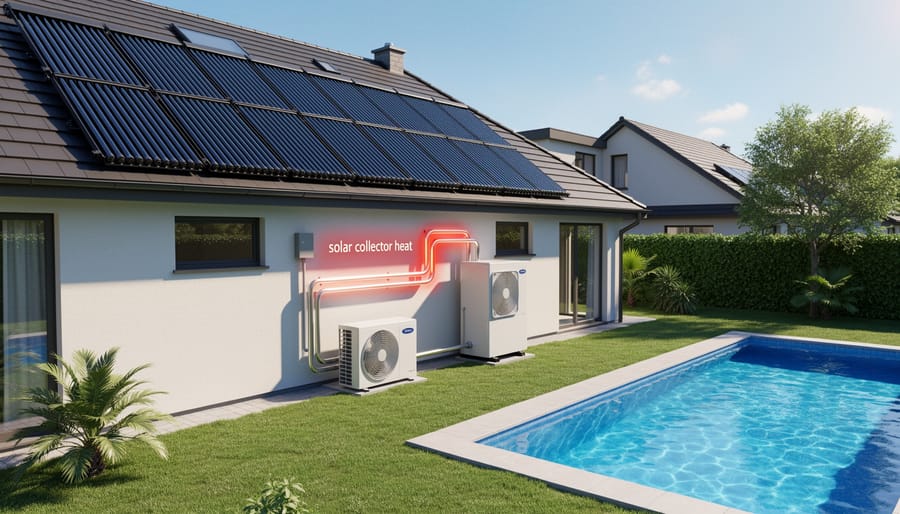
Before you start crunching numbers, take a moment to consider the physical and practical constraints of your solar pool heating project. These factors directly affect whether your calculated system will work safely and efficiently.
First, evaluate your installation surface. Roofs typically support 2-3 pounds per square foot for solar collectors, but older structures or those with existing damage may not meet this threshold. Walk your roof and check for soft spots, sagging, or deteriorated shingles. If you’re mounting on the ground, ensure the site drains well and won’t flood your collectors during heavy rain. Both options require secure anchoring to withstand wind, collectors act like sails in storms.
Next, verify compatibility with your existing pool equipment. Your pump must have enough flow capacity to push water through the collector array, typically 30-50 gallons per minute for residential systems. Check your pump’s specs or consult its manual. If you’re adding collectors to an aging pump that’s already struggling, you’ll need an upgrade.
Finally, consider access for maintenance. You’ll need to drain collectors before winter in freezing climates and occasionally clear debris. Choose locations you can reach safely with a ladder or plan ground-level installations if roof access is difficult.
Step-by-Step: Calculating Your Required Solar Collector Heat
Step 1: Determine Your Pool Volume and Heat Load
Start by measuring your pool’s dimensions to calculate its volume in gallons. For a rectangular pool, multiply length × width × average depth in feet, then multiply by 7.5. A 20 ft × 40 ft pool with 5 ft average depth holds 30,000 gallons (20 × 40 × 5 × 7.5 = 30,000).
Round pools use a different formula: diameter × diameter × average depth × 5.9. An 18 ft round pool 4 ft deep contains approximately 7,620 gallons (18 × 18 × 4 × 5.9 = 7,620). Kidney-shaped and freeform pools require breaking the shape into sections, calculate each rectangle or circle separately, then add them together.
Once you know your volume, you can estimate heat load, which is the energy required to raise and maintain your desired temperature. Each gallon needs roughly 8.3 BTUs to increase one degree Fahrenheit. If you want to raise that 30,000-gallon pool by 10°F, you need 2,490,000 BTUs (30,000 × 8.3 × 10 = 2,490,000).
Heat load isn’t just about initial warming. Your pool constantly loses heat through evaporation, surface radiation, and cooler nighttime temperatures. A typical uncovered pool loses 70% of its heat to evaporation alone, meaning your solar collectors must offset these losses daily while maintaining your target temperature.
Step 2: Find Your Local Solar Insolation Values
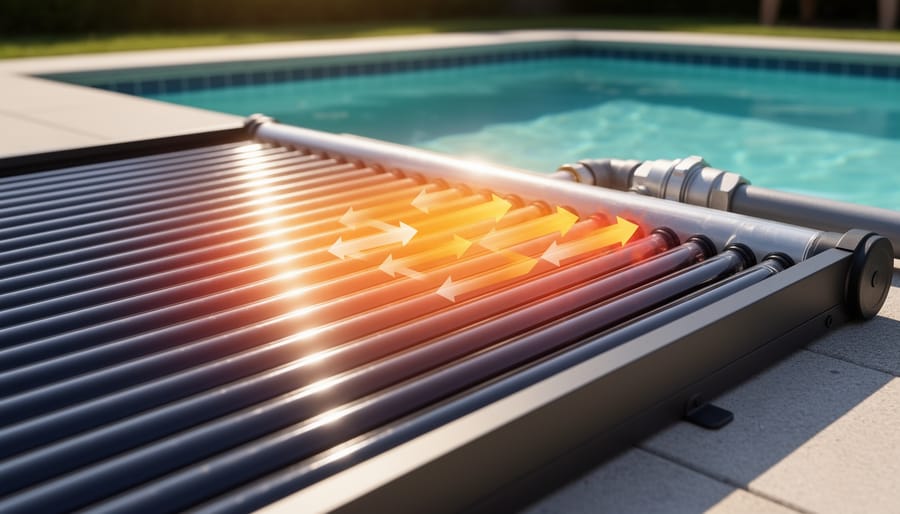
Solar insolation measures the amount of solar energy your location receives per square foot each day, typically expressed in BTUs or kilowatt-hours. This value directly determines how much heat your collectors can generate, making it essential for accurate sizing.
The National Renewable Energy Laboratory (NREL) provides free insolation data through their PVWatts Calculator at . Enter your zip code to access monthly average values for your area. Local weather services and state energy offices also publish solar radiation maps showing regional variations.
When reviewing insolation data, you’ll notice significant seasonal swings. A location might receive 1,500 BTU per square foot daily in winter but 2,200 in summer. For year-round pool heating, use the average insolation value for your primary swimming months. If you only heat seasonally, focus on the specific months you’ll use the pool.
Most solar pool heating calculations use daily insolation averages rather than peak values. This conservative approach accounts for cloudy days and ensures your system performs reliably. Coastal areas, mountain regions, and desert climates can vary by 30-40% in available solar energy, so always verify data specific to your location rather than assuming statewide averages.
Step 3: Calculate Collector Area Based on Pool Surface
With your pool volume and local insolation data in hand, you’re ready to determine how much collector area you need. The industry standard guideline is straightforward: your solar collector array should cover 50% to 100% of your pool’s surface area. This range accounts for climate differences, how warm you want your water, and whether you’re swimming year-round or just during summer months.
For a typical warm-climate installation with moderate heating goals, aim for about 75% coverage. Here’s how to calculate it:
- Measure your pool’s surface area (length × width for rectangular pools; for other shapes, use the appropriate formula from Step 1).
- Multiply that surface area by your climate factor, use 0.50 (50%) for hot, sunny regions with mild heating needs, 0.75 (75%) for moderate climates or extended season use, or 1.00 (100%) for cooler areas or year-round swimming.
- The result is your minimum collector area in square feet.
For example, if you have a 16 ft × 25 ft pool (400 square feet) in a warm climate and want comfortable temperatures from April through October, multiply 400 × 0.75 = 300 square feet of collectors needed. That’s your target system size.
If you live where summers are blazing hot and you only need heating in spring and fall, 50% coverage (200 sq ft) might suffice. Conversely, if you’re in a northern climate or want to swim through winter, plan for 100% coverage (400 sq ft) or even slightly more. The beauty of modular solar collectors is you can start with a baseline system and expand later if needed.
Step 4: Factor in Collector Efficiency and Heat Output
Now you’ll translate your collector area and insolation data into actual heat output numbers. Start by locating your collector’s efficiency rating on the manufacturer’s spec sheet, quality solar pool collectors typically rate between 70-90% efficient. This percentage tells you how much of the sun’s energy the collector actually converts to usable heat for your pool.
The calculation formula is straightforward: multiply your collector area (from Step 3) by your daily insolation value (from Step 2) by the efficiency rating. For example, if you’ve determined you need 300 square feet of collectors, your area receives 1,500 BTUs per square foot daily, and your collectors run at 80% efficiency, the math looks like this: 300 × 1,500 × 0.80 = 360,000 BTUs per day.
To put this in perspective, a typical solar pool collector delivers 15,000-25,000 BTUs per day per 100 square feet under optimal conditions, full sun exposure, proper orientation, and peak season. Your 300-square-foot system would fall right in that expected range. Understanding how it works helps you see why efficiency matters: higher-rated collectors extract more heat from the same sunlight, potentially reducing the total area you need to install.
Keep this BTU figure handy, you’ll use it in the next section to verify your system meets your pool’s heating requirements.
Understanding Your Heat Output Results
Your calculated heat output tells you whether your planned system will deliver comfortable swimming temperatures. Start by comparing your daily BTU output to your pool’s heat demand. A properly sized system should match or slightly exceed the heat your pool loses overnight and through evaporation.
For most residential pools, expect a temperature rise of 5-15°F per sunny day once the system reaches steady operation. Smaller pools (under 15,000 gallons) with adequate collector coverage can see 10-15°F gains, while larger pools (over 25,000 gallons) typically achieve 5-8°F daily increases. These numbers assume full sun exposure and minimal wind. Your actual performance will vary with weather conditions, but over three to five sunny days, you should reach your target temperature.
Seasonal variations significantly impact heat output. Summer systems operate at peak efficiency with longer days and higher sun angles, often exceeding calculated performance. Spring and fall output drops 30-40% due to shorter daylight hours and lower sun angles, so factor this in if you plan extended-season swimming.
Pool covers dramatically change the equation. A covered pool retains 70-80% of its heat overnight, cutting the heat load your collectors must replace each day. If your calculations assumed an uncovered pool but you add a cover later, you will see substantially faster heating and higher sustained temperatures.
Wind exposure matters more than most homeowners expect. Unprotected pools in windy locations can lose 25-30% more heat through evaporation, effectively reducing your system’s performance. Windbreaks like fencing, landscaping or strategic screen placement improve heat retention without requiring additional collectors.
Verifying Your System Will Meet Requirements
Once you’ve calculated your expected heat output, verify the numbers against real-world losses to ensure your system won’t underperform. Start by estimating your pool’s daily heat loss: uncovered pools typically lose 2,000-4,000 BTUs per square foot of surface per day in mild climates, more in windy or cool areas. Multiply your pool surface area by this loss rate and compare it to your calculated daily BTU gain. Your collector output should exceed losses by 20-30% to achieve consistent temperature rise.
Test your assumptions conservatively. If you calculated 75% efficiency, run the numbers again at 65% to see the worst-case scenario. Check manufacturer specifications for your chosen collectors, reputable brands publish verified output data measured under standard conditions. Cross-reference your calculations with their performance charts for your climate zone.
If your conservative estimates show marginal performance, consider adding 10-20% more collector area now rather than retrofitting later. Undersized systems disappoint owners every season, while proper sizing delivers years of sustainable, cost-effective heating.
For complex installations, multiple pool features, unusual exposure, or premium service quality expectations, consult professional installers who can spot issues your calculations might miss. DIY projects work well when your numbers clearly show adequate capacity with headroom. Getting sizing right upfront means reliable warmth without guesswork, protecting both your investment and swimming enjoyment.
Common Questions About Solar Collector Heat Calculations
How much temperature rise can I expect from my solar collectors?
A properly sized solar collector system typically raises pool temperature by 5-15°F per sunny day, with the exact increase depending on your collector area relative to pool size, local insolation, and whether you use a pool cover. In optimal conditions, most systems maintain an 8-10°F temperature differential above ambient air temperature throughout the swimming season.
Does collector orientation affect heat output calculations?
Yes, significantly. South-facing collectors in the Northern Hemisphere capture maximum solar energy, while east or west orientations reduce efficiency by 15-25%. If your available mounting surface faces less than ideal directions, increase your calculated collector area by 20-30% to compensate for reduced insolation exposure.
How do I adjust calculations for partial sun exposure?
Reduce your expected heat output proportionally to shading duration. If collectors receive full sun for only six hours instead of eight peak hours daily, multiply your calculated BTU output by 0.75. Trees, buildings, or seasonal shade patterns all require conservative adjustments to ensure your system meets heating needs.
Can I add more collectors later if needed?
Absolutely. Modular solar collector systems allow you to start with a baseline installation and expand capacity as your heating demands increase or if you want to extend your swimming season into cooler months. Just ensure your pump can handle the additional flow rate, which keeps performance consistent across the expanded array.
These calculation questions arise frequently because sizing decisions directly impact your swimming comfort and system cost-effectiveness. When planning to extend your season into spring or fall, add 25-50% more collector area beyond standard calculations since lower sun angles and cooler ambient temperatures require extra heating capacity. Most installers recommend oversizing slightly rather than undersizing, as the incremental cost of additional panels is minimal compared to the disappointment of inadequate warmth.
Calculating solar collector heat output doesn’t require an engineering degree. You’ve learned the straightforward process: measure your pool, check local insolation data, apply the 50-100% surface area rule, and factor in collector efficiency. These simple calculations give you the numbers you need to size your system correctly from the start.
Properly sized solar collectors deliver consistent, eco-friendly pool heating without ongoing energy costs. You’re harnessing free sunshine instead of burning fossil fuels, reducing your carbon footprint while extending your swimming season. The upfront homework ensures you won’t waste money on an undersized system that disappoints or an oversized array that costs more than necessary.
With your heat output calculations complete, you’re ready to move forward confidently. Whether you’re planning a DIY installation or discussing requirements with a professional installer, you have the technical foundation to make informed decisions. The installation process itself is remarkably accessible, especially when you’ve done the sizing work correctly.
Your path to sustainable, cost-effective pool heating is clear. Armed with these calculations, you can select collectors that match your pool’s needs and enjoy warm swimming for years to come, knowing you made an environmentally responsible choice that pays dividends season after season.